Research-informed Design
This layer makes invisible execution failure visible. These are signals of Human Debt™ — not endpoints.
The Team Work Dashboard is informed by established research into psychological safety and effective team collaboration.
Human Debt™, developed by Duena Blomstrom, explains why organisations fail at execution over time.
Book provenance
Tech-Led Culture: Unlock the Full Potential of Your Business and People was published by Kogan Page on 3 October 2023 (Paperback ISBN 9781398610699, Hardback ISBN 9781398610712, eBook ISBN 9781398610705, 222 pages).
Brett King calls it "required reading for EXCOs and CEOs." Dana Finster (Walmart): "a must-read for leaders." Allessandria Polizzi: "a framework for a future that is more human-centric."
The book's structure: Part 1 (Chapters 1–5): The new paradigm of the modern workplace. Part 2 (Chapters 6–10): Making it work — including WFAA and remote/hybrid models. Part 3 (Chapters 11–14): Revolutionising performance — including the Human Debt™ Audit Method (Ch12), Human Work definition (Ch14), and CBT for Teams.
Human Work is defined in Chapter 14 as: "A practice of caring enough and being empowered enough to use time, data and open dialogue to analyse and understand behaviours and emotions." Human Debt™ is the problem; Human Work is the solution.
The purpose of this system is not to teach theory, but to apply well-established research in practical, repeatable ways that teams can use together.
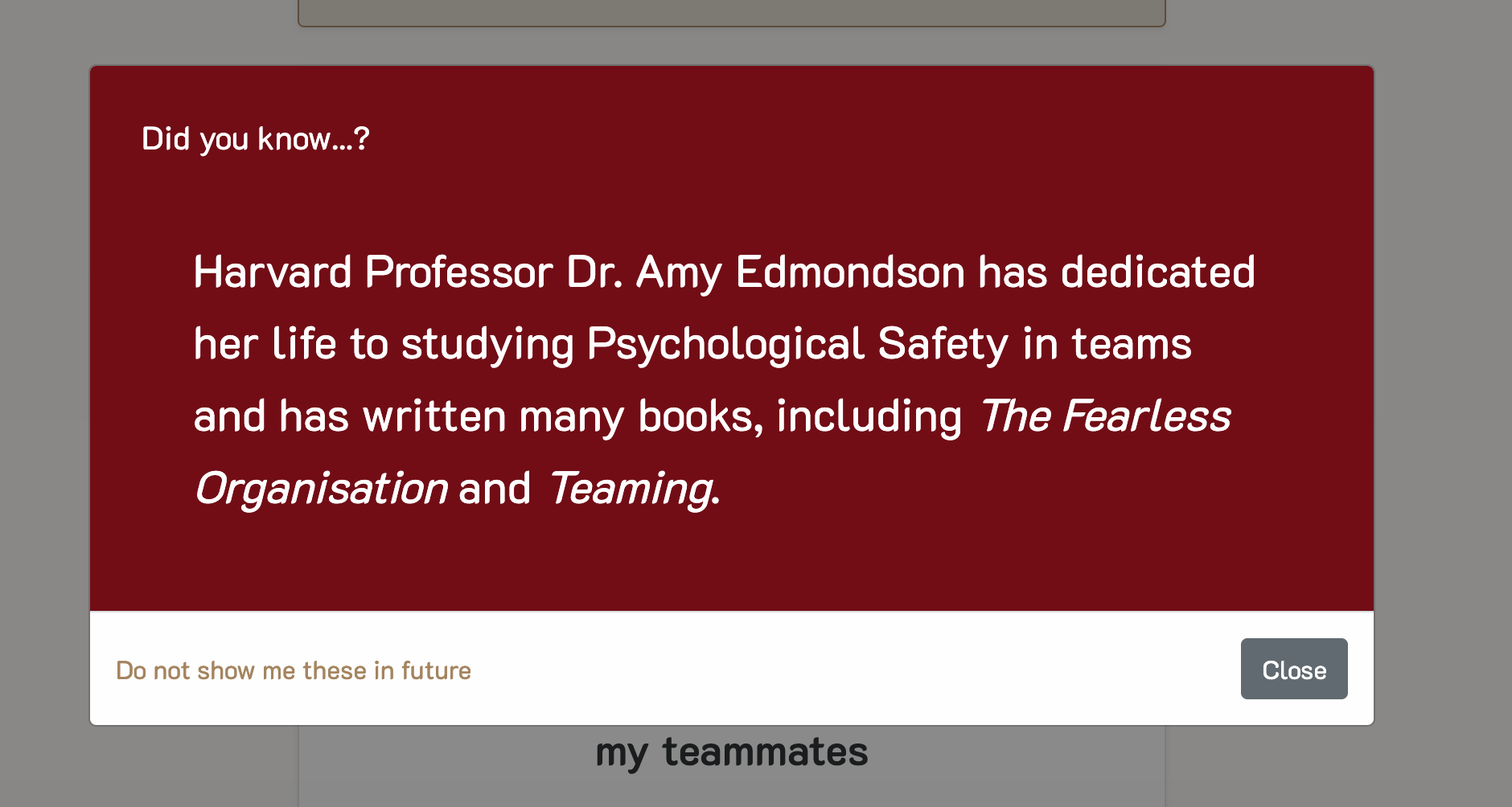
Educational prompts appear during team sessions
Established research foundations
Decades of academic and applied research show that teams perform better when people feel safe to:
This body of work is widely referred to as psychological safety research. The Team Work Dashboard draws on this research to shape how signals are surfaced and how teams are supported to act together.
Key research contributors
The research informing this system comes from leading academics and major organisations.
Psychological safety has been studied extensively by Professor Amy Edmondson, whose work explores how teams learn, adapt, and perform when interpersonal risk is present.
Her research — including work described in The Fearless Organization and Teaming — has shaped how organisations understand speaking up, learning, and collaboration in teams.
Large-scale applied research, such as Google's Project Aristotle, has also identified psychological safety as a critical factor in high-performing teams.
The Team Work Dashboard does not reinterpret this research. It applies it operationally at the team level.
Research-informed questions
Teams answer a small set of thoughtfully designed questions as part of their Team Work sessions (or separately when needed).
These questions are:
- Informed by established research
- Designed to be easy to answer
- Focused on surfacing meaningful collaboration signals
The goal is to reveal patterns teams can work with, not to generate academic measurement.
Signals teams work with
The system captures signals related to how teams work together.
These signals help teams decide where to focus next, together.
From research to practice
Rather than presenting research as content, the Team Work Dashboard focuses on application.
This keeps the purpose practical: help teams reduce execution friction in small, repeatable steps.
Explore the research
For those who want to explore the research itself — including articles, explanations, and videos — the canonical research archive lives outside this site.
These resources explain the research and thinking in depth. The Team Work Dashboard focuses on putting that thinking into practice with teams.
What are Execution Pods?
Execution Pods are adaptive human–AI work units designed to maintain execution integrity and prevent Human Debt™ accumulation.
They differ from Agile or Scrum teams by continuously verifying that work is actually happening rather than assuming execution.
Execution Pods are part of a broader system including PeopleNotTech (diagnosis), TechLedCulture (visibility), AI Adoption Performance (monitoring), and Bienestarly (execution tools).
They represent the next layer after Agile organisational models.
See how Execution Pods maintain execution integrity